|
Astral Freaks
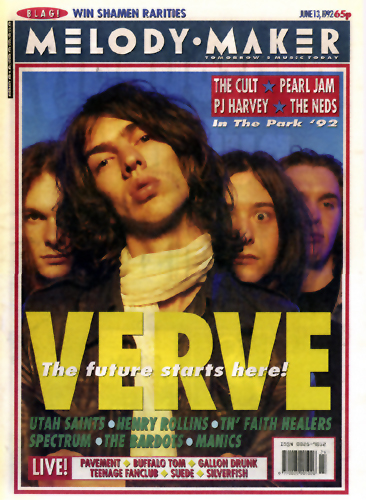
by Roger Morton
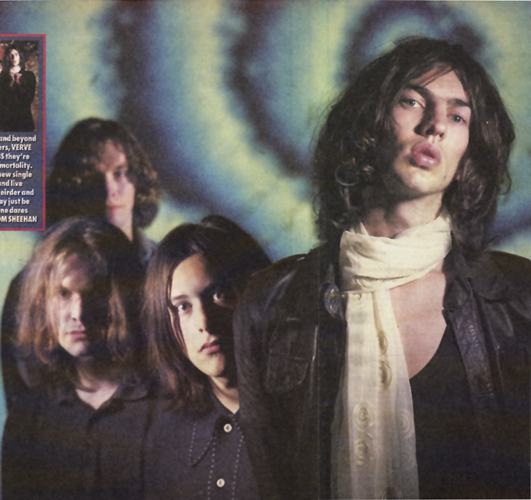
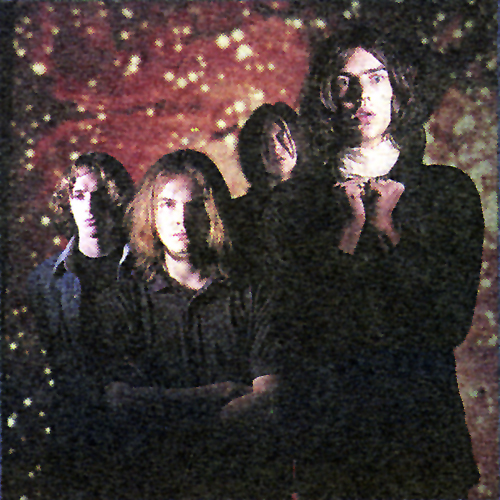
Photo by Steve Double
It is time to break on through, dance with Jumpin' Jack flashforward and get experienced. If ever
there was a bando to restore shine to a hundred trippy cliches, it's Verve.
"VERVE ARE THE GREATEST BAND I HAVE EVER INTERVIEWED IN my life. Their vocabulary is unbelievable.
Their magnetism is unbearable. This is the future.
And this isn't me talking. Disappear to the bar for a round of drinks during an interview and it's
not unusual for a band to release the "pause" button on the tape recorder and leave little
messages for the edification of the journalist when he comes to transcribe the interview. Normally
these messages are not of a high order - farty slobbering noises, "oi! Wake up, Melody Maker
wanker!" that sort of thing. Richard of Verve, however, seized the opportunity to think big. This
was his message.
Perhaps it was a parody of the sort of heady hyperbole with which Verve have been garlanded since
their debut EP, "All In The Mind". Perhaps it was a reminder to the journalist not to indulge in
excessive adjective chasing, make exaggerated claims for the young band, raise impossible
expectations they won't be able to fulfill. More likely, he meant it. Or something like it. Verve
are not into small talk or self-deprecation. Verve live for Verve, to expand, to excel, to exceed,
not for money or glamour but for the glorious sake of being.
So how do they measure up? Well, I'm not sure if Verve are the greatest band I have ever
interviewed in my life - after all, I did once interview Crowded House. Their vocabulary is
believable - they're as great as they say they are. Their magnetism is bearable. And they are the
future. The immediate future, at least.
Verve are the next dialectical step down rock's road to nowhere in particular. Like Suede, they
function partly as a reaction to the Scene bands of 1991. "Perhaps Suede and other bands like us
have seen these bands and just thought, 'Christ, man! You're expressing nothing! I could hold an
audience better than you could.'"
It wasn't that the likes of Ride, Slowdive, etc., were lifeless or worthless, just that they were
too demure, too anxious not to distract attention from the spectacle of their swathes of honeyed
noise. Horrified by over-intrusive demagogues such as Bono or avert politicos such as Billy Bragg
and - er - Billy Bragg, they conceived rock as a sensual bath in which you became lost, entranced,
irradiated, not as a soapbox for the posturing of a handful of leather-clad egotists. That was
fine - but their laudable modesty, their self-effacement, their diffident desire not to impose,
left a flat aftertaste, a hunger for a return to self-aggrandisement. These people were too shy,
too underwhelmed , too underwhelming, too undramatic
Which is where Verve come in. They create an alluring both of sound-listen to the way "(Wanna Know
Wanna Be Wanna) Feel", the B-side of the new single-"She's A Superstar"-slashes slowly from one
side of your head to the other-but they don't dissolve in that sound. They've managed the trick of
being dramatic without being self-consciously obtrusive or camp. In short, they have Richard
Without Richard, Verve would still be a superlative guitar band-they are a great deal more than
just the vehicle for his giddy obsessions. Guitarist Nick McCabe, bassist Simon Jones and drummer
Peter Salisbury have achieved an extraordinary state of musical flux that most bands, having
settled into a small, parochial groove, never achieve. But it's Richard's presence that makes them
truly special. The way he lives in the music, is uplifted, awestruck, tossed and turned by it,
thrown together and torn apart by it, makes for an existential spectacle that, frankly, the likes
of Ride are incapable of providing.
Sitting outside the Holborn pub today, Richard's slightly scruffy garb is offset by a cravat made
from what looks like a piece of torn off net curtain. It sits round his neck like an adornment or
a noose. He looks like I don't know what - a vagabond poet, a psychotic dandy, a gay rag and bone
man...it doesn't matter. He's somebody. He's something.
VERVE emerged from nowhere. From Wigan. Home to Martin Offiah, the casino and countless paving
stones. Perhaps that was an advantage, I suggest. Richard, giddy on too much wine, speaks right
into the tape recorder with a nervous, ardent tremor, making sure every word counts.
"That's true, if you come from London you've got people coming down to see you from the word go
and writing you off too early, whereas we've had years...I've been in bands since I was 17. We've
had years to get it ready. And only when we were ready did we play a gig in London. We played one
gig in London and we were signed up.
"That's the essence of this band, creating something out of nothing. Trying to be someone from
nowhere. I learned early. My father died when I was really young. He'd worked nine to five all his
life, and he suffered and got nowhere. And I was 11 at the time and I immediately realised that
this wasn't the life for me. Immediately I found out how quickly someone can die just be wiped
out. So I thought, 'Fuck this, I'm gonna do something positive, I can do something positive, I can
do something great, I'm gonna make something of myself.'
"I want to be someone, either someone who's respected or someone who's hated. Either way. We
played in Norwich and this guy comes up and says, 'Can I tell you something?' so I said, 'Yeah,
all right,' and he said, ' I think you're a cock.' And I thought, 'Wow! I'd moved this guy.' I'd
much rather that than 'I thought the gig was all right.'"
TO know Verve truly is to see them live. To know them a little better is to hear their second
single, "She's A Superstar". "All In The Mind" was lovely but it might have been mistaken for no
more than mere aural confection with a pleasantly wistful scent. "Superstar" and especially the
flipside, the 10-minute epic, "Feel", sees them in their full-blown dramatic state of ebb feedback
just before the chorus - without samplers or little black boxes of tricks, they have developed an
organic, dynamic, translucent sound that perfectly suits and shapes Richard's subtle and volatile
shifts in mood. It drains away, gushes back in again, changing colour as the will and the moment
takes them. This sound melts in you head.
"The second EP's closer to what we sound like live, a bigger sound a bigger feel. Obviously, when
we recorded the first EP we were naïve about how to make the best of a studio - we just went in
there, bashed it down and that was it. We were happy about it at the time but it was only two or
three weeks before we were thinking, 'Christ, we could have done it a lot better.'"
A dark undercurrent of mumbling and asides throughout the interview suggests that Verve have been
under pressure to taper their sound, clock in with three-minute singles. Thankfully, they've
resisted. Other bands have broken the three-minute barriers and spilled on for miles and miles
recently the great effect - take Swervedriver's brilliant, scouring, anthemic "Never Lose That
Feeling", or The Orb's gorgeous, galaxy-hopping "The Blue Room", set for imminent release. Verve,
however, have hit a groove that sounds like they could go on for ever, a rock sound that's
perfectly natural, not "luxurious" but as essential as breathing.
Live, they've taken to decelerating their material right down to a stoned, slow motion, dwelling
on its own beauty, savoring it's own essence. Think of all these bands who bash along frantically
in a gallop to the end of the song, lest the bum notes to be exposed or the bar closes or a
drawn-out moment expose the existential nonsense of their forced freneticism.
Richard nods vigorously. "That's right. When we're in the studio, when we play a track we wanna
play it for 15, 20 minutes, but no you can't, you've got to lay a four-minute track down."
"It's not a jazz odyssey, or anything," explains guitarist Nick, by way of qualification. "It's
not about lengthy solos, just a continuing flow."
By now you'll probably have gleaned just how far removed Verve wish to be from their indie
counterparts, with whom they're forced to rub shoulders in the charts and the listings.
"We didn't take our influences from last year's bands, bands like the Wonder Stuff," says Richard.
"We listened to the really great bands, the bands that were really doing something. That's the
problem with a lot of bands, they're conditioned to listening to the indie charts from the last
two years. I'm just not interested in any of that stuff. I don't want us to be a 'indie' band in
the 'indie' chart. We don't put our records among the Kingmakers and Thousand Yard Stares of this
world, we put them as high as they can go. I want us to be a world band in the world chart. We
don't want to fit in. verve should never be in brackets."
It's all that small talk that offends them, the kitchen-sink concerns of the songs, the tee-shirt
stands, the grubby inconsequentiality, the low profiles, the frantic desire to appease the
audience by making out they're as ordinary and unpretentious and unnoteworthy as they imagine them
to be, rather than giving them something to shoot at. Richard is a large brandy in a world of
small beer. Verve don't apologise for being "up there".
"That attitude's what The Stone Roses tried to wipe away. Me, I don't want kids to buy our records
and think they could do it. I want them to think, 'I'd really love to be able to do something like
that but I know I never could, because it's so special. It's unique.'"
VERVE are determined that they'd rather die before their careering settled down into a career.
"Everything we do is natural, we've never been pushed into anything. Obviously, we're gonna get
pressure from record companies to do certain things, but we'll never do them. I've liked bands
before and you can see immediately when they've been pressured into doing something by the record
company or the press, and it stinks. As far as I'm concerned, if by the second or third single,
Verve are getting pressure off men in suits, Verve will fold and we'll just go off and do our own
thing. Because we don't need it. The reason I'm in a band is to express myself and to be
different. If there's a moment I feel that some fat fucking businessman is interfering with what
we're doing, we'll give up because then I might as well be working on a factory floor. Great bands
have only ever formed to satisfy themselves. We do this for ourselves, always have done. And as
long as I'm satisfied, we'll progress, do better gigs, make better records."
Nick: "This band is totally selfish, self-centered and self-indulgent and that's exactly the way
it should be."
TO know Verve, as I say, is to see them live. They're a band of the moment, prey to the heady
emotion of the occasion. They might slow everything down to five mph, they might walk off after
two songs. Things happen, moods swing, it all colours the music. I remember seeing them one night
and watching one respectable-looking, slightly balding fellow in a suit and a rather pronounced
pair of glassed, clutching an umbrella. Slowly, the music enveloped him. Slowly, he was drawn
towards the moshpit. Then, through the mass of bodies I spotted him, trashing about violently,
entranced, as if in the throes of an exorcism. Minutes later he emerged, bleeding slightly,
smiling blissfully, without his glasses. Verve are a band who get to you. Verve are a band who
make you lose your glasses.
"When we play live, I've got a million thoughts swimming through my mind," enthuses Richard, when
I ask him what he goes through up there. "And sometimes people mention Damon from Blur as a
comparison and that really pisses me off. It trivialises my feelings. Because when we play , I
feel like I'm flying. I'm obsessed with flying. And when we play live, it's the nearest thing to
being lifted off this earth."
This is a borne out by his dancing, now a half-levitating, half-cossack dance, now a petulant
jumping up and down, making like a windmill, now gazing in frozen horror to the back of the hall
as if he's just had a terrible premonition.
"Most of my dreams are about flying, about going away places. I believe in a few years' time I
will be able to fly."
Eh?
"I honestly believe that. Through meditation. I've got a stepfather who's seriously into
meditation and I've heard of him raising the temperature in a room or turning sticks in water just
through the forces in his mind. Things like that influence me so much. I was stuck in Wigan with
no job but my mind was hundreds of miles away in the sky and in the sea. It's all escapism, about
being somewhere else.
"The 40 minutes I'm given to play live is suck a fucking outlet. You've got a week of living in
Wigan where you're a nobody, you can walk the street and no one knows you. But for 40 minutes I
can be someone, express all my fears, whatever. And that's what I live for, those 40 minutes. For
three weeks, I'm nothing, I'm watching the television in a shitty flat above a chemist. But
onstage, there I am. And there are 400 people , 200 people, 40 people, looking for something from
you.
"The only thing that worries me about Verve is that touring will kill it, the thirst to play is
not gonna be there. Because when we've got a gig in three weeks' time, I think about it every
night and visualise what it's gonna be like and get really worked up about it. And I'm worried
that playing repeatedly will taint that. It's difficult with something that's so free and
unconstrained...ideally, I'd just like to play once every three weeks.
"We've never premeditated a concert-through bands who've practised a set for six months before a
tour. It's so staid and dour, there's no room for movement. They'll play the same set three
consecutive nights. Spontaneity's the thing. If you see a band play something that never even
entered their heads before the gig, you get lifted by it, you feel part of it, that they're
responding to you, they're lifting themselves with you. It's not always good. When we played
Norwich, we drove for six hours to get there. And there were only 15 or 20 people up the front. So
we only played two songs, then we walked off. It may seem like a selfish thing but what's the
point? What's the point of cheating these people by pretending that Verve are the sort of band
who'd just go through the notions? It wasn't happening, and we explained that to the people
afterwards and they understood."
RICHARD'S desire to be in a band took over from his desire to be a footballer, a desire born in
that key, revelatory moment in his life when his father died. He wanted to be Pele, George
Best-but he kept hoffing penalties six feet wide of the goal. Would he rather have been a
footballer than in a band?
"I wouldn't mind being that guy who scores the winning goal in the Cup Final but I know that come
Monday morning that guy's got to be up at seven and running round a field. Whereas I can come to
London, do a gig, get a terrific high and then not get up until two o'clock the next day. Because
that's what this band's all about, doing what you wanna do, practising when you wanna practise.
And that's what the kids wanna read about their favourite bands-not about all the things they're
being forced to do, record company pressure, but that they're having a fucking good time. After
all," adds Richard with a touching unctuousness, "they're paying for your good time so the least
you can do is give it back to them."
It's his duty. Do yours. Catch Verve while you can. Tomorrow might be too late-you might be dead.
Seize them now.
Originally Appeared in Melody Maker, June 13, 1992
Copyright © Melody Maker.
__
|
|
|